Reflection for the Third Week of Advent
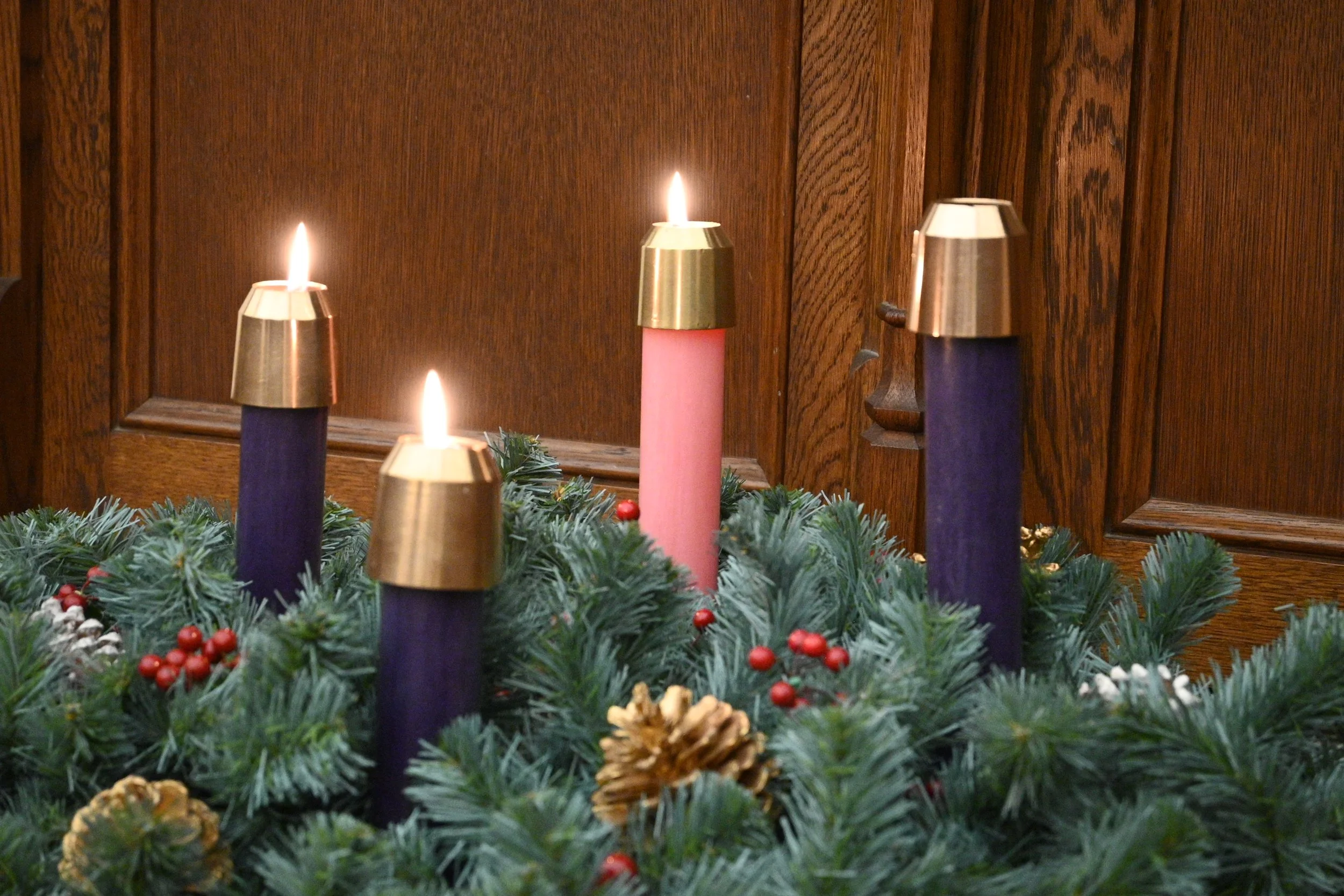
Poinsettias seem to be everywhere during Advent and Christmas. With their leaf-like petals in shades of red, white, and pink, they adorn Christmas trees, altars, and storefronts.
What I find most astonishing is that you can turn white poinsettias red by placing them in the dark! I only know this because my mom tried it over the span of two years. The first year, she placed white poinsettias by the bay window of our living room and shut the curtains. Day after day, she would look at them with anticipation: “Are they turning red? Oh, they’re turning pink! They must be on their way to turning red!” But sadly, they stayed pink. The reason was that our living room has an open-space floor plan, which allowed light from other parts of the house, not just the window, to reach the poinsettias. In order to turn red, they needed complete darkness.
The next year, my mom tried again. But this time, she placed the white poinsettias in a room in our basement. This room is enclosed with four walls, so when you shut off the lights and close the door and curtains, it is completely dark. My mom left her poinsettias there for several weeks. And guess what? They turned red!
The theme of joy amidst the darkness of the desert pervades today’s readings. When we are in spiritual darkness, our hearts are like my mom’s poinsettias: They are being put in darkness for the sake of transforming them into something more beautiful.
What God desires is the beauty of our souls. When God created the world through His Word, He imprinted upon our souls His very own image and likeness, which endowed them with a beauty other creatures lacked. When our First Parents sinned, we fell under the natural law of death. At the appointed time, the Word of God, Our Lord Jesus Christ, took on human flesh and entered our suffering humanity to save us from our bondage to sin and death. This tremendous event – the Incarnation of the Word and His Birth – are what we celebrate during Advent and Christmas.
As we wait for the Messiah to return again, let us not forget that He is waiting for us, too! He is waiting for us to say “yes” to the deeper transformation He wants to work in us, to restore us to the beauty of His image and likeness. This beauty makes us fit for heaven, for our life of eternal beatitude with Him. This Advent, we can ponder: What can I do to prepare my heart to receive the Word more fully? How can I be more open to the transformation God wants to work in me?
Waiting in the darkness of the desert can be painful, filled with trials, temptation, spiritual dryness and fatigue. But we can rejoice because these trials draw forth from our hearts greater acts of faith, hope, and charity; a greater sense of our poverty before God; and a greater understanding of how much God loves us. It is then that our hearts are transformed to the image and likeness of God, and restored to their beauty. Then we can rejoice as the flowers of virtues and good works bloom in our hearts! With the prophet Isaiah, we can cry, “The desert and the parched land will exult; the steppe will rejoice and bloom. They will bloom with abundant flowers, and rejoice with joyful song” (Isaiah 35:1-2).
St. John the Baptist understood this keenly, and that’s why he is a model of joy amidst the darkness of the desert. At the sound of the Blessed Virgin Mary’s greeting, he “leapt for joy” in the womb of his mother (Luke 1:41, 43) because he recognized she carried the Messiah, the one for whom ancient Israel had been longing for ages. As the “voice of one crying out in the desert” (Matthew 3:3; John 1:23; cf. Isaiah 40:3), he exhorted people to “repent” – literally, to turn their thoughts back to God – “for the kingdom of heaven is at hand” (Matthew 3:2). His life was totally ordered toward the coming of the Messiah, and the Church unites herself to his desire in the liturgy of Advent (Catechism of the Catholic Church 524).
In today’s Gospel, we find St. John the Baptist in the darkness of Herod’s prison. He had heard of Jesus’ miracles, and his heart was bursting with joy because it seemed like Jesus was fulfilling all the Messianic prophecies from times past! How excited must he have been to send his disciples to Jesus to confirm, “Are you the one who is to come, or should we look for another?” (Matthew 11:3). Jesus dispels their darkness by conveying his miracles are a fulfillment of Isaiah’s prophecies: “Go and tell John what you hear and see: the blind regain their sight, the lame walk, lepers are cleansed, the deaf hear, the dead are raised, and the poor have the good news proclaimed to them” (Matthew 11:4-5; cf. Isaiah 35:5-6).
In the midst of darkness, St. John the Baptist’s joy must have been magnified by these words of Jesus! The one whose coming he had proclaimed his whole life, was now proclaiming to him that He had indeed come! St. John the Baptist had been imprisoned, and would eventually be condemned to die, for defending the sanctity of marriage, for speaking out against Herod’s adulterous, incestuous relationship with his sister-in-law (Mark 6:17-29; Matthew 14:3-12). But this could not detract from the deeper joy within him. As the “friend of the bridegroom” (John 3:29), St. John the Baptist rejoiced that Christ, the Bridegroom, had come to wed His divinity to our humanity. He who pointed out the Lamb of God rejoiced to see Jesus inviting us to the Wedding Feast of the Lamb in Heaven, the city where no darkness reigns “for the glory of God will give it light, and its lamp will be the Lamb” (John 1:29, 36; Rev 19:7). Let us rejoice with him!